

The term "enterprise AI solutions" now appears on nearly every digital transformation agenda. AI adoption at the enterprise level is no longer an experiment, it's part of a measurable operational strategy and business transformation plan.
Yet for many organizations, the term still feels too broad to translate into a concrete strategy. Questions pile up: “What technology are we actually talking about? What categories exist? Which platform is the right fit? What does implementation look like at enterprise scale?”
This guide answers those questions, from the definition and categories of enterprise AI solutions, to the leading global platforms, to a practical framework for choosing the right solution for your business.
What are Enterprise AI Solutions?
Enterprise AI Solutions are a category of artificial intelligence technologies designed to meet the needs, standards, and complexity of large-scale organizations. Unlike generic AI tools, they're built to integrate directly into existing systems, processes, and workflows, while maintaining security, data governance, scalability, and operational continuity.
Three pillars separate enterprise AI solutions from everyday AI tools:
- System Integration: connects directly to ERP, CRM, data warehouses, and existing IT infrastructure.
- Enterprise-Grade Standards: layered security, data privacy, access control, audit trails, and regulatory compliance.
- Lifecycle Support: from pilot and deployment to ongoing monitoring and continuous model updates.
Four trends have defined enterprise AI solutions over the past three years (2024–2026):
- Shifting focus from experimentation to measurable ROI
Enterprises now scrutinize the business case and financial impact of every AI initiative, rather than adopting the latest technology by default - Generative AI as the entry point
ChatGPT, Claude, and other LLMs triggered mass adoption, but organizations are realizing they need a more mature data strategy and governance model to sustain it - Governance and compliance becoming a priority
Data privacy regulations (GDPR, Indonesia's PDP Law) are driving demand for transparency, explainability, and bias controls in AI models - Rising MLOps maturity
Enterprises now recognize the need for infrastructure to manage, monitor, and continuously update AI models at scale
Also Read: Panduan Memilih AI Consultant Indonesia untuk Enterprise
Why Do Businesses Need Enterprise-Scale AI?
Enterprise organizations operate with volumes of data, users, systems, and regulatory requirements that far exceed what generic AI tools were built to handle. Key drivers behind enterprise AI adoption include:
- Operational Efficiency: automating repetitive processes that have historically consumed time and human resources
- Data-Driven Decision Making: turning operational data into real-time, actionable insight
- Scalability: solutions that grow alongside data volume and user count without sacrificing performance
- Compliance & Governance: meeting industry regulatory requirements (banking, energy, healthcare) with structured audit trails
A snapshot of AI use cases across sectors and the business impact they deliver:
| Sector | AI Use Case | Business Impact |
|---|---|---|
| Manufacturing | Computer vision for quality control and visual inspection | Lower defect rates, improved production line efficiency |
| Financial Services | Document intelligence for KYC and automated contract review | Faster onboarding, reduced compliance risk |
| Energy & Utilities | Predictive analytics for asset maintenance | Downtime prevention, optimized operational costs |
| Retail & E-Commerce | AI-driven personalization and demand forecasting | Higher conversion, more efficient supply chain |
| Logistics | AI orchestration for routing and dispatch | Faster deliveries, lower transportation costs |
| Agribusiness | Predictive analytics for yield and risk management | Optimized production, mitigated weather and supply risk |
Also Read: Panduan Strategis Custom AI Solutions untuk Perusahaan
Categories of Enterprise AI Solutions
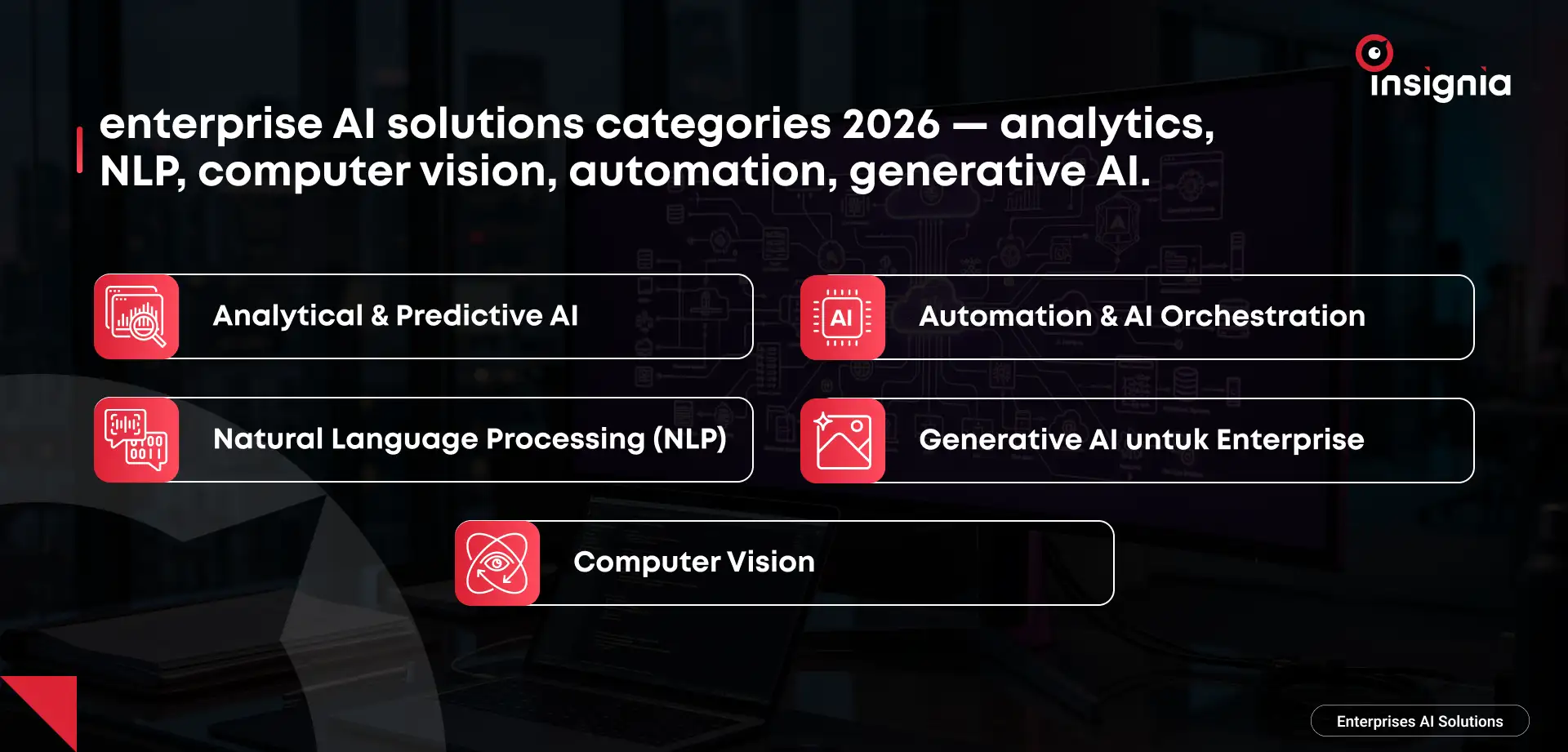
Enterprise AI solutions aren't a single monolithic system, they span a range of technology categories, each designed to solve a different class of business challenge. Understanding these categories is the first step toward choosing the right solution.
1. Analytical & Predictive AI
This category covers machine learning technology that analyzes historical and real-time data to generate accurate projections, detect anomalies, and support decision-making. Applications range from demand forecasting to fraud detection to predictive maintenance.
Use cases:
- Sales forecasting based on historical data and market trends
- Real-time fraud detection in financial transactions
- Predictive maintenance to reduce operational downtime
Key requirement: Scalability and performance to handle massive data volumes without latency, enterprises can't tolerate prediction delays as data volume keeps growing.
Best for: Organizations with large operational data volumes that need trend-based decision-making.
2. Natural Language Processing (NLP) & Document Intelligence
NLP enables computers to understand and generate human language at scale. Document Intelligence specifically handles complex documents, such as invoices, agreements, and reports, that have historically been processed manually.
In an enterprise context, this means full automation from unstructured documents to analyzable insight.
Use cases:
- Automated data extraction from invoices, contracts, and financial reports
- Internal chatbots for knowledge base and employee FAQs
- Sentiment analysis from customer feedback and service transcripts
Key requirement: Data security and privacy.NLP processing often involves sensitive documents, so enterprises must ensure end-to-end encryption and data residency compliance.
Best for: Organizations with large volumes of unstructured documents that need text extraction or insight analysis.
3. Computer Vision
Computer vision automatically analyzes images and video to produce actionable information. At enterprise scale, it's used for quality control, infrastructure inspection, security monitoring, and identity verification, with a level of consistency and speed manual processes can't match.
Use cases:
- Quality control otomatis di lini produksi manufaktur
- Inspeksi visual infrastruktur dan aset dari drone atau camera feeds
- Pemantauan keamanan fasilitas dengan alert otomatis
Key requirement: System integration. Vision systems must plug into existing production control or surveillance infrastructure without a full migration, keeping the feedback loop real-time.
Best for: Manufacturing, infrastructure, or security organizations that need visual inspection automated at scale.
Also Read: Why Modern Businesses Are Prioritizing IT Optimization Over Expansion
4. Automation & AI Orchestration
This category combines Robotic Process Automation (RPA) with AI to automate complex, adaptive workflows. Unlike traditional RPA, which only follows fixed rules, AI orchestration can handle variation, exceptions, and decisions that require business context.
Use cases:
- Multi-level approval processes with context-based automated routing
- End-to-end employee onboarding, from document verification to IT setup
- Cross-system data reconciliation with automated exception handling
Key requirement: Governance and explainability. Orchestration systems need to be transparent in routing or exception decisions, with full audit trails and the ability to explain AI decisions to stakeholders.
Best for: Organizations with complex, multi-step, variable processes that require context for decision-making.
5. Generative AI for Enterprise
Generative AI (GenAI) enables automatic content, code, summary, and answer generation from natural language instructions. In enterprise settings, this takes shape as employee copilots, Retrieval-Augmented Generation (RAG) systems for knowledge bases, and contextual document search.
Use cases:
- AI copilots for drafting emails, reports, and proposals
- Code generation and debugging for engineering teams
- Knowledge base search that understands context and user intent
Key requirement: Data security and privacy plus custom training. Enterprise generative AI needs to support private or fine-tuned LLMs trained on internal data, keeping proprietary information confidential while staying relevant to industry context.
Best for: Organizations looking to boost employee productivity and speed up content or code creation with secure, integrated AI copilots.
6. MLOps & AI Governance Platform
As enterprises manage more AI models simultaneously, the need for a platform to govern the model lifecycle becomes critical. AI governance platforms add explainability (XAI), decision audit trails, and compliance controls.
Use cases:
- Automated deployment and versioning for dozens of concurrent production models
- Drift monitoring with automated retraining when performance degrades
- Audit trails and explainability for compliance and risk management
Key requirement: Enterprise SLA and support. MLOps platforms must guarantee uptime, 24/7 support, and dedicated infrastructure so operations aren't disrupted by model failures or infrastructure issues.
Best for: Organizations with mature AI practices that need to manage many production models reliably and in compliance with governance standards.
Leading Enterprise AI Platforms from Global Providers
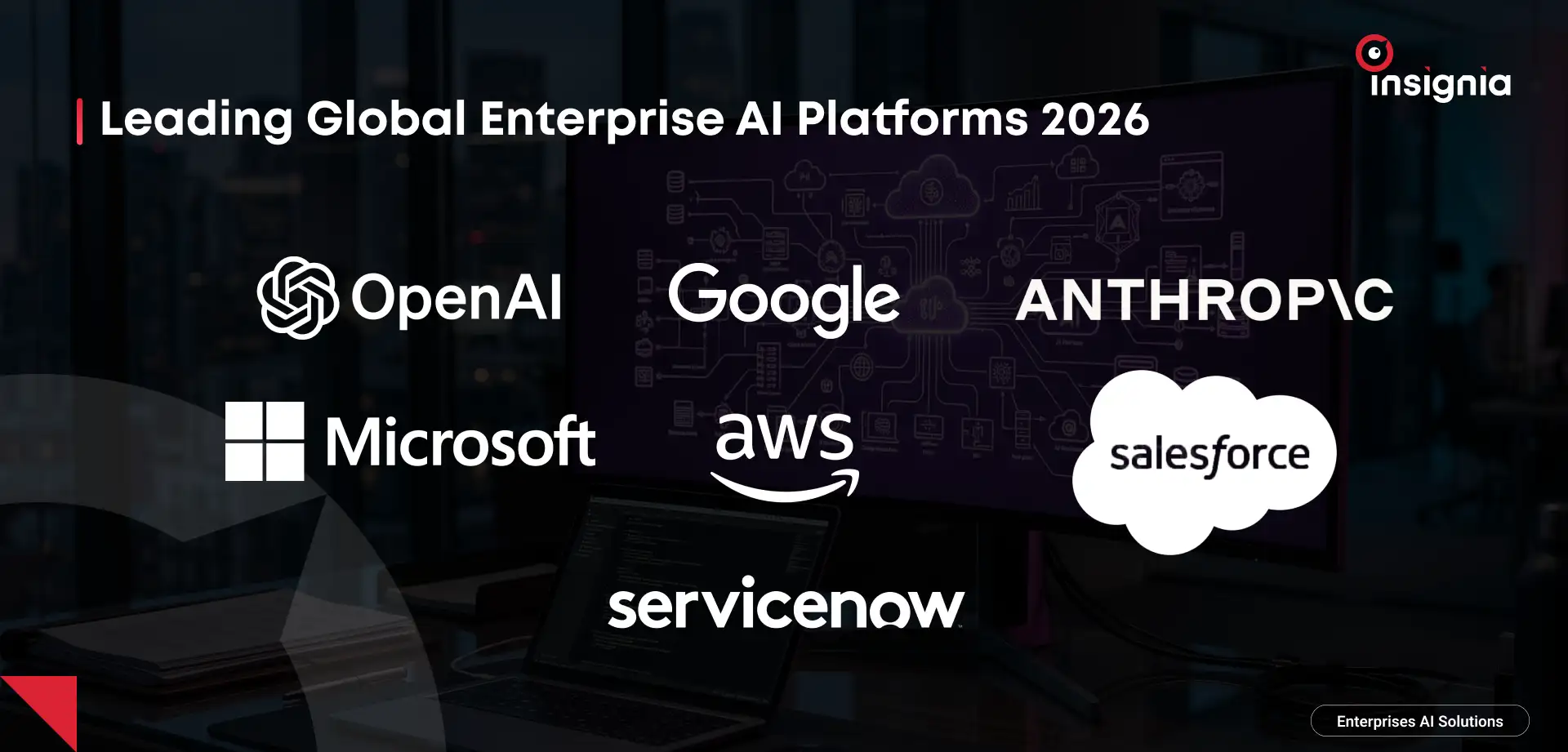
A range of technology companies now offer AI platforms purpose-built for enterprise needs. Here are seven leading platforms widely adopted by large organizations worldwide, along with their strengths and best-fit use cases:
| Enterprise AI Platform | Strength | Best for |
|---|---|---|
| ChatGPT Enterprise by OpenAI | Advanced reasoning, organizational data privacy, custom GPTs, API integration | Enterprises wanting the strongest LLM-based employee copilot with full privacy control |
| Gemini for Workspace / Vertex AI by Google | Multimodal AI, deep Google Cloud ecosystem integration, enterprise search | Companies already on Google Workspace or Google Cloud |
| Claude Enterprise by Anthropic | Long context window (up to 200K tokens), safety-by-design, deep document analysis | Enterprises needing large-document analysis, code, and deep reasoning |
| Microsoft 365 Copilot / Azure OpenAI by Microsoft | Native integration with Word, Excel, Teams, Outlook; enterprise-grade Azure infrastructure | Companies already on Microsoft 365 / Azure |
| Amazon Bedrock by AWS | Multi-model choice (multiple LLMs via one API), AWS infrastructure, enterprise security | Enterprises wanting model flexibility on AWS cloud infrastructure |
| Einstein AI / Agentforce by Salesforce | Native CRM AI, autonomous agents for sales and service, AI-powered Customer 360 | Companies focused on Salesforce-based sales, marketing, and service automation |
| Now Assist / ServiceNow AI by ServiceNow | AI for IT service management, operational workflow automation, HR & employee service | Enterprises looking to automate IT, HR, and internal services |
Each of these platforms excels in a different context. In practice, enterprises often combine more than one, for instance, Microsoft 365 Copilot for employee productivity alongside AWS Bedrock for custom AI applications.
Also Read: Databricks Delivery Partner Indonesia: Apa yang Perlu Diketahui Bisnis?
How to Choose the Right Enterprise AI Solution
Choosing an enterprise AI solution is a strategic decision, not merely a technical one. Here are six evaluation steps to use as your starting framework:
- Identify Priority Use Cases
Start with one or two business problems with the highest value to solve with AI. Don't try to implement everything at once, focus on the highest-impact first. - Assess Data Readiness
Enterprise AI solutions need a clean, structured, accessible data foundation. Audit data quality, completeness, and accessibility before choosing any solution. - Evaluate the Right Architecture
Determine whether the solution should run in the public cloud, in a hybrid environment, or on-premises based on your security, latency, and industry regulatory needs. - Check Security, Privacy, and Compliance
Confirm the solution meets applicable regulatory requirements and supports your company's data security policies. - Test Integration with Core Systems
Verify how the solution connects to your ERP, CRM, data warehouse, and other core systems without a risky full migration. - Run a Limited Pilot Before Scaling
Validate the solution in a real-world context with a limited scope first. Evaluate whether the pilot delivers real business value before committing to full-scale investment.
Furthermore, you can also view a more in-depth guide on how to evaluate enterprise AI consultants to support the development of your enterprise AI solutions.
Why Businesses Trust Insignia with Their AI Solutions
Insignia (PT Kreasi Media Asia) is an AI Transformation Consultant based in Jakarta, Indonesia, helping enterprises adopt enterprise AI solutions strategically and with measurable outcomes.
Insignia isn't just a platform vendor, we act as a partner that helps companies identify the right AI solution, prepare the data foundation, implement it, and ensure adoption actually succeeds.
Insignia's AI solutions are engineered by proven experts, built to accelerate performance and maximize your R.O.A.I. (Return on AI Investment):
- AI Agent Creation
Move beyond repetitive tasks and focus on higher impact. Our AI Agents learn, adapt, and optimize workflows continuously to drive measurable efficiency. - GenAI Studio
Bring your AI vision to life faster than ever. From simple chatbots to sophisticated analytics, GenAI Studio unifies the entire process on a single secure platform. - Private LLM
Elevate your enterprise with a fully customized and privacy-first LLM, opening the door to advanced language processing capabilities without compromising compliance or corporate governance.
Insignia follows a user-centric methodology built around three stages: 1) Strategic Assessment & Roadmap, 2) Rapid Prototyping & Validation, and 3) Scalable Deployment & Continuous Optimization.
Learn more about Insignia's AI Solutions →
FAQ: Questions About Enterprise AI Solutions
- What are enterprise AI solutions?
Enterprise AI solutions are AI technologies designed to meet the scale, security, and complexity needs of large organizations, spanning predictive analytics, NLP, computer vision, automation, generative AI, and MLOps platforms. - What are the main categories of enterprise AI solutions?
There are six core categories: Analytics & Predictive AI, NLP & Document Intelligence, Computer Vision, Automation & AI Orchestration, Generative AI for enterprise, and MLOps & AI Governance. Choosing between them depends on your business priorities and data readiness. - Which enterprise AI platform is most widely used by global companies?
Leading platforms include ChatGPT Enterprise (OpenAI), Gemini for Workspace and Vertex AI (Google), Claude Enterprise (Anthropic), Microsoft 365 Copilot and Azure OpenAI (Microsoft), Amazon Bedrock (AWS), Einstein AI and Agentforce (Salesforce), and Now Assist (ServiceNow). The right choice depends on your existing technology ecosystem and priority use cases. - What role does Insignia play in implementing enterprise AI solutions?
Insignia acts as an AI Transformation Consultant, guiding enterprises from strategy and solution selection through data readiness, implementation, and end-user adoption. - How do I get started on my enterprise AI solutions journey with Insignia?
Start by assessing your company through our contact page. Insignia's team will evaluate your data and system readiness, map out the highest-value AI use cases, and build an implementation roadmap suited to your company's scale and industry.
Make Enterprise AI Solutions Your Competitive Edge
Enterprise AI solutions are no longer optional, they're the infrastructure businesses compete on in the digital era. The companies that succeed aren't the ones adopting the most AI; they're the ones choosing the right category of solution, building a strong data foundation, and integrating AI into their business processes in a structured way.
Insignia is here to guide every stage of that journey, from strategy and platform evaluation to implementation and adoption.
Schedule a consultation with the Insignia team and start your enterprise AI transformation today →
