

Choosing an AI development partner is a different decision from hiring an AI consultant. A consultant helps you decide what to build. A development partner is the team that designs, builds, tests, and maintains it.
Many companies blur the two. They judge a builder on strategy slides, or a strategist on engineering depth, and end up with a partner who looks impressive in a pitch but struggles once the work moves into production.
This guide explains what AI development services include, when you need them, the types of partners available, and the criteria and red flags to check before you sign a contract.
What are AI Development Services?
AI Development Services are the work of designing, building, deploying, and maintaining custom artificial intelligence solutions, from machine learning models and generative AI applications to AI embedded in the systems a business already runs on.
This is different from AI consulting, which focuses on advisory work such as roadmaps and use-case prioritization. AI development is technical execution, judged by the tech stack, development methodology, and the quality of what ships.
Most AI development engagements fall into five service areas:
- AI Strategy & Feasibility:
Assessing whether a use case is viable and drafting a technical roadmap before development begins. - Custom Model Building:
Designing, training, and fine-tuning machine learning models or large language models (LLMs). - Generative AI & AI Agents:
Building chatbots, content generators, and agentic workflows that handle multi-step tasks. - Data & MLOps Infrastructure:
Building data pipelines, feature stores, and secure, scalable deployment and monitoring frameworks. - System Integration:
Embedding AI capabilities into existing enterprise software such as CRM and ERP.
If you are still defining your overall AI adoption strategy rather than scoping a build, start by reading the articles: “A Guide to Choosing an AI Consultant in Indonesia for Enterprises” and “Enterprise AI Solutions: How to Choose the Right One in 2026.”
When do You Need an AI Development Partner?
You need an AI development partner when a ready-made tool cannot solve your problem, and you lack the in-house capacity to build the alternative. Three scenarios usually signal this:
- Custom models or applications:
Your use case isn't covered by generic AI platforms, so you need a solution built around your data and business processes. - Integration with legacy systems:
AI must connect to a CRM, ERP, or other system that has run for years, which requires integration engineering rather than a tool recommendation. - A proprietary data advantage:
You want to build a competitive edge from internal data that competitors don't have, so a generic solution isn't enough.
Which Option to Choose: Build, Buy, or Partner?
| Option | Best when | Main trade-off |
|---|---|---|
| Buy (Off-the-shelf AI tools) | The need is common and speed matters most | Limited customization and integration; your process adapts to the tool |
| Build in-house | You already have an established AI/ML team and long-term capacity | Slow to hire for, and demands |
| Partner | You need custom capability and speed without a large permanent team | MLOps and governance skills Requires careful vendor selection and clear IP terms |
Before approaching any partner, check 3 things: 1) A clearly defined business problem, 2) Data of sufficient quality, and 3) An internal team ready to adopt the result. No partner can compensate for a missing foundation.
For a deeper look at tailored builds, see Custom AI Solutions: A Guide to Building Tailored AI Systems.
Types of AI Development Partners
AI development partners fall into four broad types. The right one depends on how well-defined your project is and how much of the work you want to outsource.
- Software House / AI Tech Provider
Deep engineering execution for building models and applications, usually with a stronger technical portfolio than advisory work. Best for: Well-defined builds with a clear specification. - End-to-End AI Integrator
Strategy, development, and deployment combined in one engagement. Best for: Companies that want a single partner from planning to production. - Boutique AI / ML Studio
A small team with deep specialization, such as computer vision or natural language processing. Best for: Narrow, highly specific technical problems. - Talent Augmentation
Adds AI/ML specialists to your internal team instead of outsourcing the whole project. Best for: Companies with a technical team that needs extra expertise.
Also read: Strategi Adopsi AI untuk Bisnis Sesuai Skala Perusahaan
How to Evaluate an AI Development Partner
Test the project first, then test the partner. A strong partner won't just agree to build; it will ask whether the project is ready to build. The five gates check:
- Value – “Is this problem genuinely worth solving for the business?”
- Data – “Is the data you need available and of good quality?”
- Feasibility – “Is the use case technically achievable?”
- Risk – “What are the risks, and how will they be mitigated?”
- Adoption – “Will the team actually use the solution?”
The most common mistake is debating which model to use (GPT, Claude, Gemini, or open-source) before you answer these five questions.
Seven Criteria for Evaluating an AI Development Partner
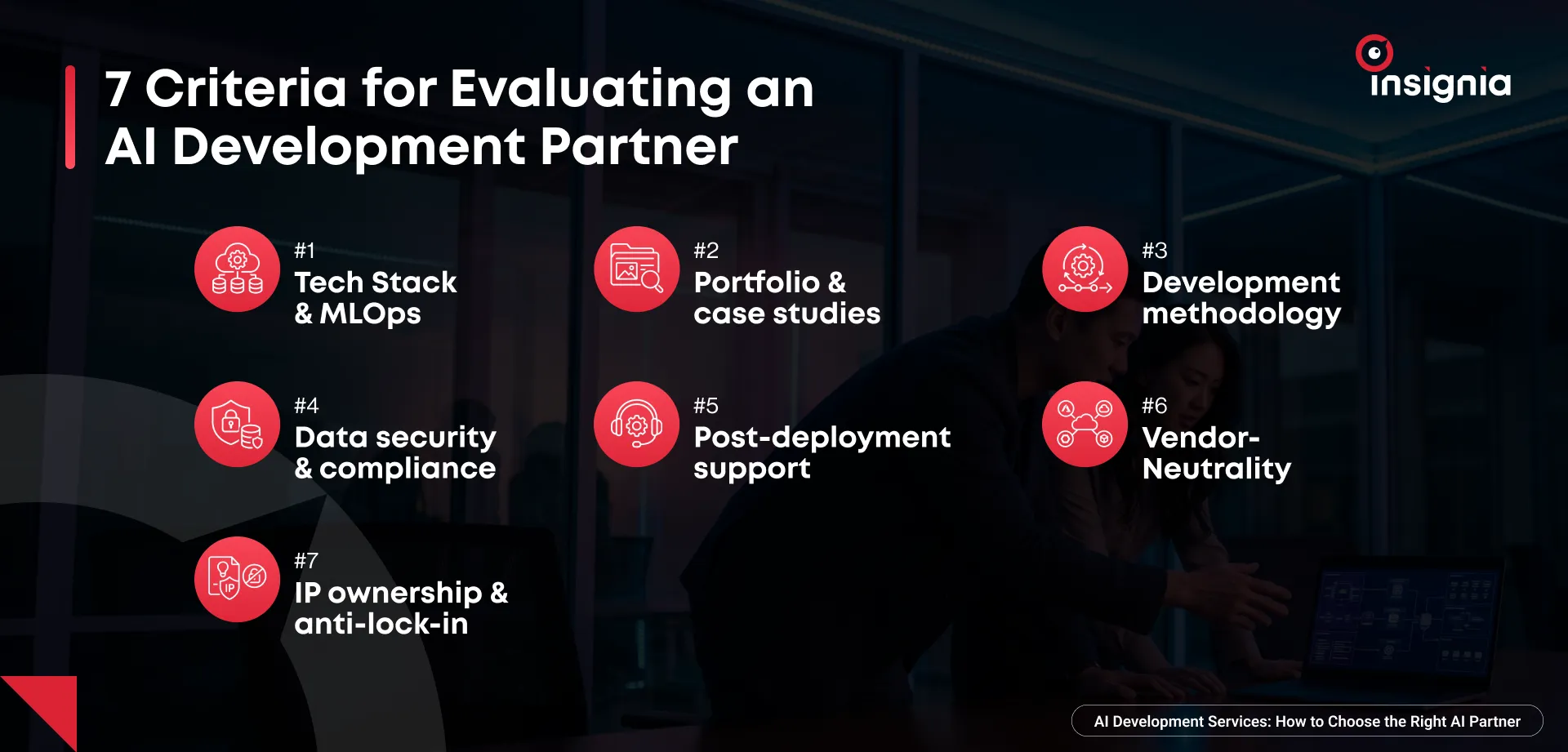
Once the project passes the five gates, use these seven criteria to assess candidates:
| No | Evaluation Criteria | What to Check | Why it Matters |
|---|---|---|---|
| 1 | Tech stack & MLOps | ML frameworks, cloud capabilities, and deployment pipelines | Determines scalability and compatibility with your existing systems |
| 2 | Portfolio & case studies | Past AI development projects relevant to your industry, with verifiable outcomes | Real evidence of execution rather than claims |
| 3 | Development methodology | Agile or sprint process, plus QA and testing designed for AI models | Keeps development structured and auditable |
| 4 | Data security & compliance | Data handling, access control, and fit with regulations such as Indonesia’s Personal Data Protection Law (UU PDP) and sector rules like OJK | Protects sensitive data and keeps you compliant |
| 5 | Post-deployment support | A plan for monitoring, retraining, and maintenance after go-live | AI models drift and need upkeep; a handover is not the finish line |
| 6 | Vendor neutrality | Whether the partner pushes one platform or model, or chooses based on your needs | Avoids solutions shaped around the vendor’s interests |
| 7 | IP ownership & anti-lock-in | Contract clauses on who owns the data, models, and code, and how portable the solution is | Prevents long-term dependence on a single vendor |
Red Flags When Choosing AI Development Partner
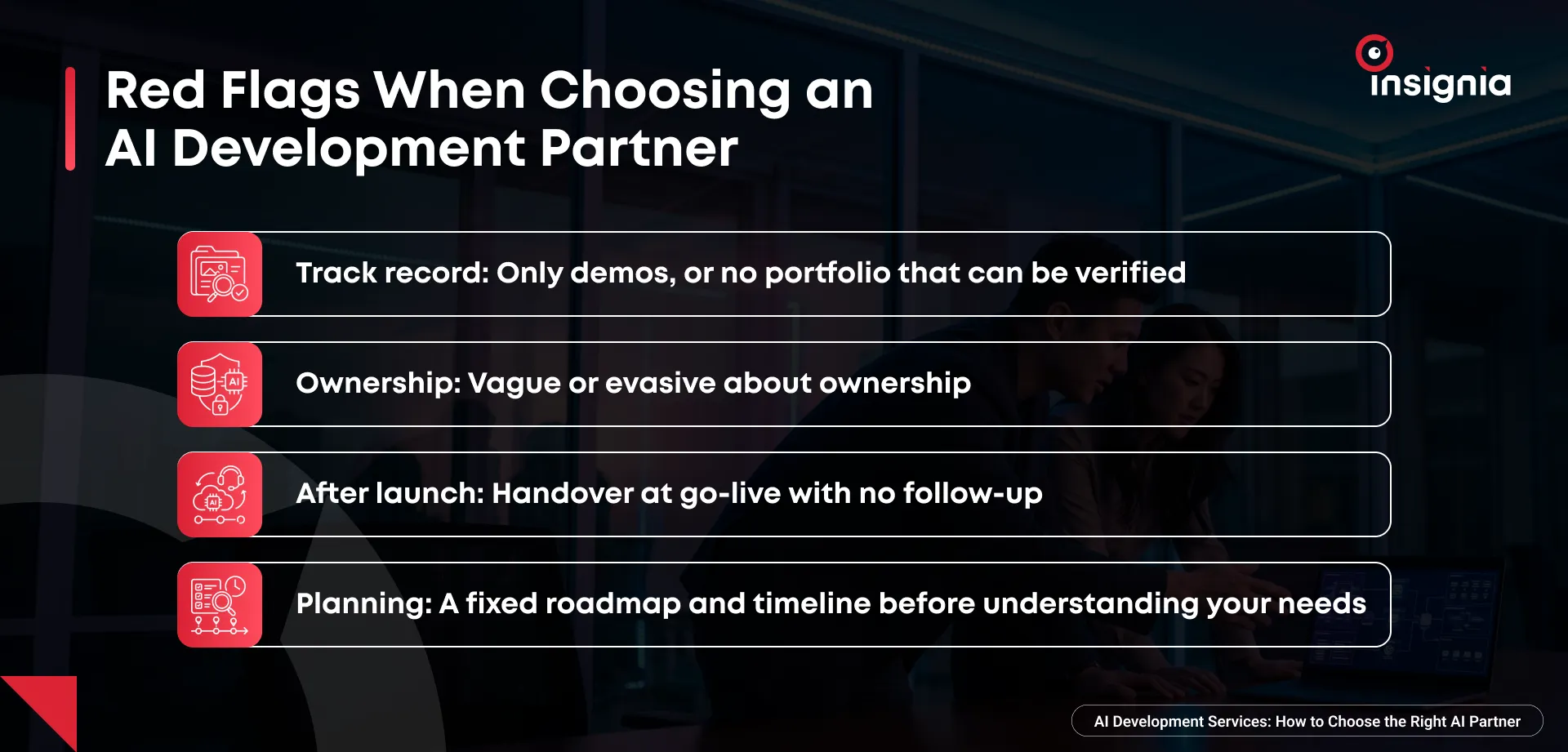
Alongside the criteria above, watch for these signals before signing:
- Track record: Only demos, or no portfolio that can be verified
- Technical depth: Buzzwords, or “we’ll use the latest model” with no reasoning
- Ownership: Vague or evasive about ownership
- After launch: Handover at go-live with no follow-up
- Planning: A fixed roadmap and timeline before understanding your needs
- Candor: Agrees to everything
Also read: Panduan Memilih AI Consultant Indonesia untuk Enterprise
How an AI Development Project Typically Runs
A well-run AI development project moves through stages with clear exit criteria, so you can stop, adjust, or scale at each step. A typical flow looks like this:
- Discovery and feasibility: define the business problem, success metrics, and technical viability.
- Data preparation: assess, clean, and structure the data the solution depends on.
- Prototype and validation: build a limited version to prove value before scaling the investment.
- Build and integration: develop the full solution and connect it to existing systems.
- Testing and evaluation: measure accuracy, reliability, and security against agreed criteria.
- Deployment and optimization: go live, monitor performance, retrain, and improve over time.
How Insignia Supports Enterprise AI Development
Insignia is an AI Transformation Consultant in Indonesia that combines AI and data capabilities for enterprise needs. Its integrated approach helps companies build AI around their own data and processes, rather than adapting to generic tools. The solutions include:
- AI Agent Creation: AI agents that automate business workflows
- GenAI Studio: generative AI applications tailored to business processes
- Private LLM: language models built on a company’s internal data
- AI integration into existing business systems such as CRM and ERP
Every project follows 3 stages: 1) Strategic Assessment & Roadmap, 2) Rapid Prototyping & Validation, and 3) Scalable Deployment & Continuous Optimization, with post-deployment support so the solution stays relevant over time.
The goal is R.O.A.I. (Return on AI Investment): measurable impact, not just a completed project.
Insignia’s capabilities are reinforced by its partnership with Databricks. Insignia joined the Databricks Delivery Provider Programme (DPP), an invitation-only programme. Databricks said Insignia is only the second Indonesian-founded company admitted, and that it acts as a certified delivery extension of Databricks’ Forward Deployment Engineering (FDE) team, designing and deploying enterprise data platforms on lakehouse architecture and Unity Catalog governance (Marketing-Interactive, 13 July 2026).
Details of Insignia’s AI development capabilities are on the AI Solutions page.
FAQ: Questions About AI Development Services
- What are AI development services?
AI development services are the design, build, deployment, and maintenance of custom AI solutions, from machine learning models to generative AI applications, including integration into existing enterprise systems. The focus is technical execution rather than advisory strategy. - What is the difference between AI development services and AI consulting?
AI consulting focuses on advisory work such as building a roadmap and prioritizing use cases. AI development services focus on the technical execution needed to build those solutions. - When should a company hire an AI development partner instead of building in-house?
Hire a partner when you need custom capability and speed but lack an established AI/ML team, or when the project requires integration and MLOps skills you do not have internally. Building in-house makes more sense when you already have the team and long-term capacity. - What should I look for when choosing an AI development partner?
Seven criteria matter most: tech stack and MLOps capability, portfolio and case studies, development methodology, data security and compliance, post-deployment support, vendor neutrality, and clear IP ownership with no lock-in. - What are the red flags of an unreliable AI development partner?
The main warning signs are no verifiable portfolio, vague answers about data and model ownership, no post-deployment plan, and a fixed roadmap or timeline offered before assessing your needs. - How long does an AI development project take?
It depends on scope, data readiness, and integration depth. A focused proof of concept can take weeks, while a production-grade system usually takes months. A credible partner defines milestones and success metrics after an initial assessment, not before. - How do I start an AI development project with Insignia?
Start with an assessment of your business needs and data readiness. You can talk to the Insignia team before defining the scope and timeline of the project.
Choose an AI Development Partner With Confidence
Choosing the right AI development partner means evaluating technical execution concretely, not just the quality of a presentation. Companies that examine the tech stack, portfolio, methodology, and IP terms up front avoid the most common reason AI projects fail midway.
Insignia is ready to help your company build custom AI solutions, from assessment through post-deployment.
Contact the Insignia team to start an AI readiness assessment →
